A practical buyer’s framework for comparing off-the-shelf software, platform customization, and a fully custom build—without assuming one route is always better.
Once a product brand decides that customers need a more interactive way to explore product options, the next question is not simply “custom or SaaS?” There is a third route too: extending an existing platform. The right choice depends on the product rules, the buying journey, the systems already in place, and what the business needs to control after launch.
When I assess this decision, I start with the requirements that must work in real life—not with a software demo or a dramatic 3D render. A polished demo can show what is possible. It cannot, by itself, prove that a solution can handle your combinations, connect to your data, fit your sales process, or remain maintainable as the product changes.
This guide is designed to help product brands compare three implementation paths, ask better questions, and make a decision they can explain internally. It is not a claim that custom development is always better. In many cases, an off-the-shelf platform is the sensible choice.
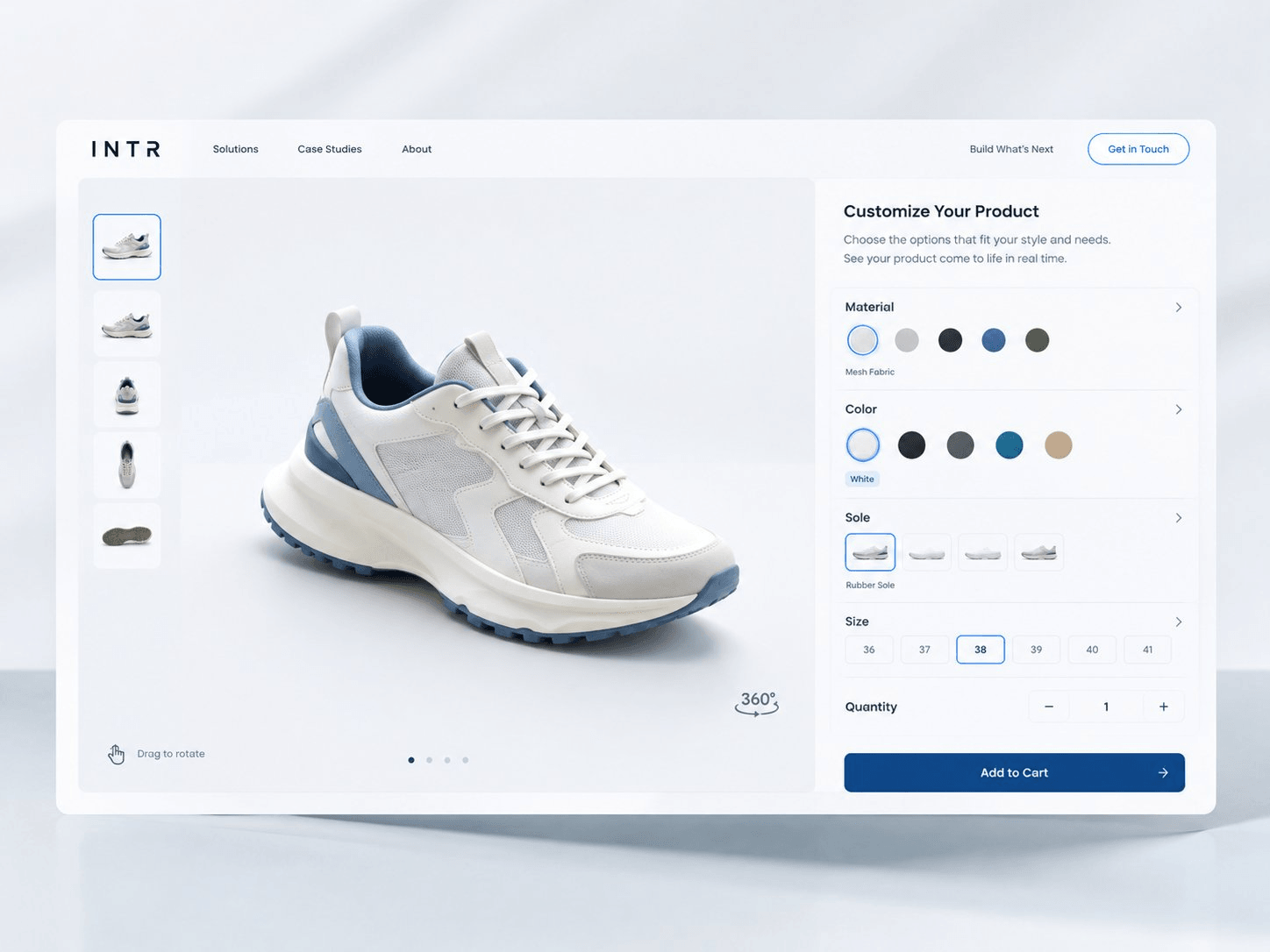
Concept interface, not a client project. A 3D configurator for footwear, showing how options, materials and pricing can sit beside a rotatable product model.
1. Start with a Buyer’s Scorecard
Before comparing vendors, write down what the configurator must do and how important each requirement is. The scorecard below keeps the discussion anchored in your product and business instead of letting a feature list decide for you.
| Decision dimension | Questions to ask | Evidence to request |
|---|---|---|
| Product logic | How many choices interact? Are there dependencies, invalid combinations, dimensional constraints, or bundles? | A walkthrough using one real product and at least one invalid or restricted combination. |
| Experience and brand | How much control do you need over the interface, product presentation, guided flow, and mobile behavior? | A prototype or implementation example that shows the actual interaction—not only a static render. |
| Data and commerce | Must choices map to product IDs, SKUs, prices, inventory, quotes, carts, or orders? Which system owns each field? | A simple data-flow diagram, interface list, and description of error and fallback behavior. |
| Time and total cost | What is included in setup, subscriptions, 3D asset preparation, integration, testing, training, support, and future changes? | A scoped estimate with assumptions, recurring fees, exclusions, and responsibilities. |
| Ownership and handover | What code, 3D assets, configuration rules, documentation, and deployment materials will be delivered? What depends on a third party? | A deliverables schedule, licensing terms, and a clear explanation of what can be exported or maintained. |
| Future flexibility | How will you add product variants, new rules, channels, or integrations? What happens when the platform or business changes? | A change scenario: what can your team update, what needs vendor support, and how updates are tested. |
Use two separate scores. First, give each dimension an importance weight from 1 to 3 (1 = useful, 2 = important, 3 = critical). Then rate how well each route meets that dimension from 1 to 5, but score only what has been demonstrated or documented—not what a sales presentation says is “possible.” Multiply weight by fit score to compare totals.
A weighted score is a conversation aid, not a substitute for judgment. If a route fails a non-negotiable requirement—such as a required integration, a specific ownership term, or a product rule—it should not win simply because it scores well elsewhere.
| Dimension | Weight (1–3) | SaaS fit (1–5) | Platform customization fit (1–5) | Full custom fit (1–5) |
|---|---|---|---|---|
| Product logic | ___ | ___ | ___ | ___ |
| Experience and brand | ___ | ___ | ___ | ___ |
| Data and commerce | ___ | ___ | ___ | ___ |
| Time and total cost | ___ | ___ | ___ | ___ |
| Ownership and handover | ___ | ___ | ___ | ___ |
| Future flexibility | ___ | ___ | ___ | ___ |
| Weighted total | — | ___ | ___ | ___ |
Scoring note: rate each route against your requirements, not against a general idea that “custom” must score higher. Ask suppliers to explain the evidence behind each score.
2. Compare the Three Implementation Routes
Route A: Use an off-the-shelf SaaS configurator
A ready-made platform can be the best fit when the product options and buying process are relatively standard, the vendor’s capabilities match the must-have requirements, and the team wants to launch without commissioning an entire system from scratch. A mature platform may already include a configuration engine, administration tools, hosting, and integrations that would otherwise need to be planned and built.
The trade-off is not that SaaS cannot be customized or integrated; some platforms support extensive configuration, APIs, embeds, and commerce connections. The question is whether the specific product, plan, and implementation can deliver the experience and control you need. Check interface limits, supported rules, data access, export options, recurring fees, usage limits, and what happens if you change platforms later.
Route B: Customize an existing platform
Platform customization can make sense when the core product already fits but the project needs a different interface, additional rules, custom data mapping, or a tailored buying flow. It may preserve useful platform capabilities while avoiding the cost and responsibility of rebuilding every component.
This route depends on the boundary between the platform and the custom layer. Confirm which changes are supported, which rely on APIs or extensions, whether updates can break the customization, who maintains each part, and whether key requirements depend on a vendor-specific feature or plan. Ask the supplier to demonstrate the exact requirement that makes your project non-standard.
Route C: Build a fully custom experience
A fully custom build is worth evaluating when important product or business requirements do not fit existing tools cleanly—for example, a distinctive customer journey, complex product rules, a tightly defined connection to existing business data, or project-specific expectations for handover and control. It gives the team more direct influence over the experience and implementation choices, but it also creates more responsibility for specification, testing, maintenance, and future development.
Custom does not automatically mean cheaper, faster, or more flexible in every practical sense. The result depends on the scope, quality of the product data and 3D assets, integration complexity, acceptance criteria, and who will maintain the experience after launch. A custom project should begin with a clear scope and an honest discussion about what is included, what is excluded, and what will be needed later.
| Route | Often fits when… | Verify before deciding |
|---|---|---|
| Off-the-shelf SaaS | Requirements are standard and the platform already covers the important interactions and workflow. | Plan limits, customization boundaries, integration specifics, recurring fees, data export, and exit options. |
| Platform customization | The platform meets most needs, with a manageable gap in UI, rules, data mapping, or workflow. | Extension limits, update compatibility, responsibility split, and the cost of maintaining custom additions. |
| Full custom development | Important requirements are not well served by an existing platform and justify a tailored solution. | Scope, asset readiness, integration work, acceptance tests, maintenance ownership, and handover terms. |
3. How to Tell Whether a Supplier’s Answer Is Generic
A good supplier should be able to connect its proposal to your actual product and workflow. Instead of asking only whether a feature is supported, ask the supplier to walk through a realistic case from beginning to end.
- Show one valid configuration and one invalid or restricted combination. What prevents the invalid choice, and how is the reason explained to the user?
- Trace one selection into the data it produces. Does it map to a product variant or SKU, a price, a quote, a cart item, or another output? Which system is the source of truth?
- Show how a product change would be maintained. Can your team update a price, rule, or product option? Does that require a specialist, a vendor ticket, or a code release?
- List the project handover items. Clarify source code, runtime assets, editable 3D source files, documentation, third-party licences, deployment materials, and exclusions separately.
- Explain the project estimate through assumptions and acceptance criteria. Ask which product data, model preparation, integrations, devices, and test scenarios are included.
Be cautious with answers such as “everything is customizable,” “we integrate with any system,” or “you own everything” when they are not followed by concrete definitions. They may describe a direction, but they are not a scope. A useful proposal explains boundaries, dependencies, evidence, and the decisions that still need to be made.
4. Treat E-commerce Integration as a Defined Workstream
A 3D scene changing on screen does not automatically mean the selected product is valid, available, or ready to buy. Before connecting a configurator to an existing store or database, map the data and responsibilities involved.
- Product catalogue: Which system owns the product record, attributes, identifiers, and variant definitions?
- Configuration rules: Where are allowed combinations and dependencies maintained, and how are rule changes reviewed?
- Price and availability: Are these fixed, calculated, or retrieved from another system? How current must the information be?
- Downstream output: Does the selected configuration produce a SKU, a bundle, a specification, a quote request, a cart item, or an order payload?
- Failure handling: What happens if the data source is unavailable, a variant is discontinued, or a price changes during the session?
Not every configurator needs every connection. Some experiences are designed to help a buyer explore and then contact sales; others need to pass a defined configuration into an e-commerce flow. The architecture should follow the business task rather than adding integrations because they sound impressive.
If you are working with Shopify, our separate guide explains how a custom 3D experience can sit alongside the existing commerce layer: How to add a 3D configurator to Shopify. For a broader overview of e-commerce use cases, see our e-commerce configurator guide.
5. Define What You Receive After the Project
The live experience is only one part of a project. Before signing, make the handover concrete. “Source code included” or “3D assets included” can mean different things unless the contract identifies exactly which items are included and which remain subject to third-party licences or separate agreements.
- Project source code: specify which repositories, components, services, and build files are part of the delivery.
- 3D assets: distinguish optimized runtime files from editable source models, CAD data, textures, and original working files. Do not assume every format is included unless it is listed.
- Product rules and data mapping: document where options, dependencies, identifiers, and integration mappings live, and how they can be changed.
- Deployment and technical notes: define what installation or deployment instructions, environment settings, testing results, and handover sessions will be provided.
- Rights and third-party dependencies: identify licensed libraries, hosting services, platform subscriptions, and content whose use is governed by separate terms.
- Post-launch responsibilities: set out defect correction, support, upgrades, monitoring, and future feature work separately from the original build.
At INTR, we treat the project scope and agreed handover as part of the delivery conversation—not as a detail to settle after the demo is approved. The specific deliverables should be stated in the project agreement so both sides know what can be maintained, transferred, or extended.
6. Examples from Real Product Experiences
The best format depends on what buyers need to understand. Two examples from INTR’s public project library illustrate different goals rather than a single universal template.
Outer’s outdoor furniture configurator supports modular combinations, fabric selection, accessories, and multiple viewing angles. It is an example of a product where buyers benefit from exploring choices in one interactive 3D scene.
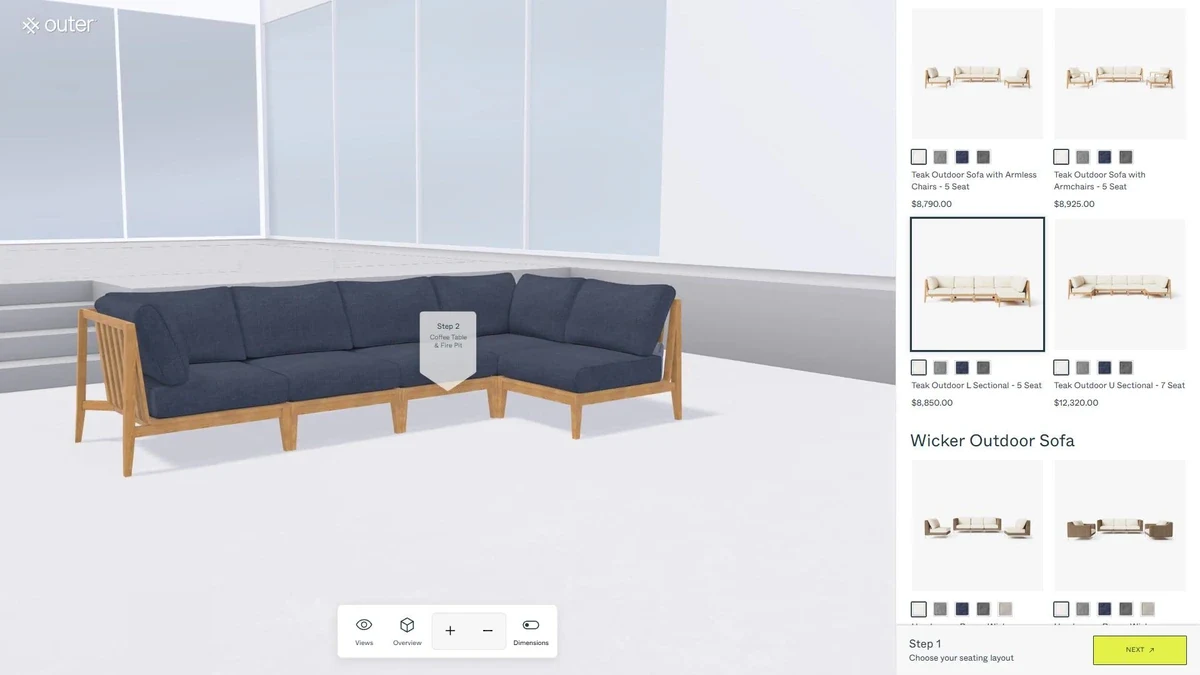
OUTER outdoor furniture configurator — a real INTR project.
ZONSEN’s C2M motorcycle customization experience presents a motorcycle through an interactive, browser-based 3D experience with an Explore mode. It shows a different need: helping a buyer inspect and understand the product in context. The public project evidence should not be read as proof of every possible vehicle-fitment, inventory, or commerce integration.
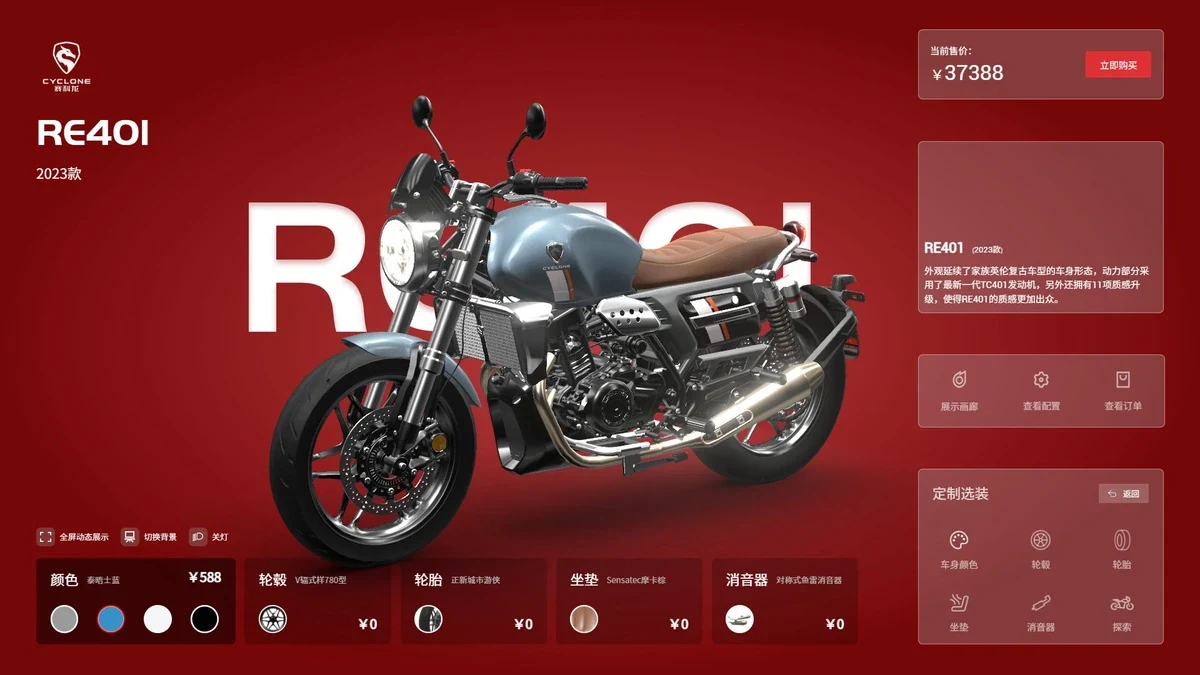
ZONSEN RE401 motorcycle configurator — a real INTR project.
These projects do not mean every brand needs a fully custom configurator. They show why the interaction should follow the product task: configure combinations when that is the goal, or make the product easier to inspect when exploration is the more important job.
7. When Does Full Custom Development Make Sense?
Consider a custom route when several of the following are true:
- The product has meaningful option dependencies or combinations that the available platform cannot handle in a clear, maintainable way.
- The buyer journey is a differentiating part of the brand experience, and standard UI or workflow constraints are material.
- The experience must map choices to an existing product catalogue or specific business process, with data responsibilities clearly defined.
- The project has concrete requirements for code, assets, documentation, deployment, or long-term control that need to be addressed contractually.
If your requirements are standard and an existing platform meets them with acceptable cost and control, SaaS may be the better choice. The scorecard is meant to make that conclusion easier—not to lead every reader to custom development.
If you are comparing options for a product with complex combinations, a distinctive interactive journey, or specific integration and handover requirements, explore INTR’s 3D Product Configurator service or contact us to discuss your requirements. A useful first conversation starts with the product, its rules, the existing systems, and what a successful handover should include.
Frequently Asked Questions
Is a custom 3D product configurator always better than SaaS?
No. SaaS is often sensible when the product logic, customer experience, and integrations fit what the platform already provides. Custom development is worth evaluating when important requirements do not fit or need a different level of control.
Does choosing SaaS mean I cannot integrate with my e-commerce system?
No. Some SaaS products offer embeds, APIs, and commerce integrations. Check whether the exact data objects, events, plan, and workflow you need are supported, and identify any extra work or fees.
Does “source code included” mean I receive every 3D source file and all rights?
Not necessarily. Source code, optimized 3D runtime assets, editable model files, third-party libraries, and intellectual-property rights are different things. Define each item and its licence or ownership terms in the agreement.
What should I prepare before asking for a proposal?
Prepare a representative product, the choices customers need to make, known rules or restricted combinations, current product-data sources, desired sales flow, available 3D assets, and handover expectations. A concrete brief makes proposals easier to compare.
The practical takeaway: choose the implementation route that fits the real product rules, customer journey, data environment, and long-term responsibilities. A configurator is successful when the product and business workflow agree—not simply when the 3D model looks impressive.
Related reading: fully custom 3D product configurator service · what a 3D product configurator is · 3D product configurator for e-commerce