A furniture product page shows one staged photograph. The buyer is standing somewhere else entirely — with oak flooring, a specific wall colour, a room of a particular size and a sofa that has to work in all three. The gap between that photograph and that room is where furniture returns come from.
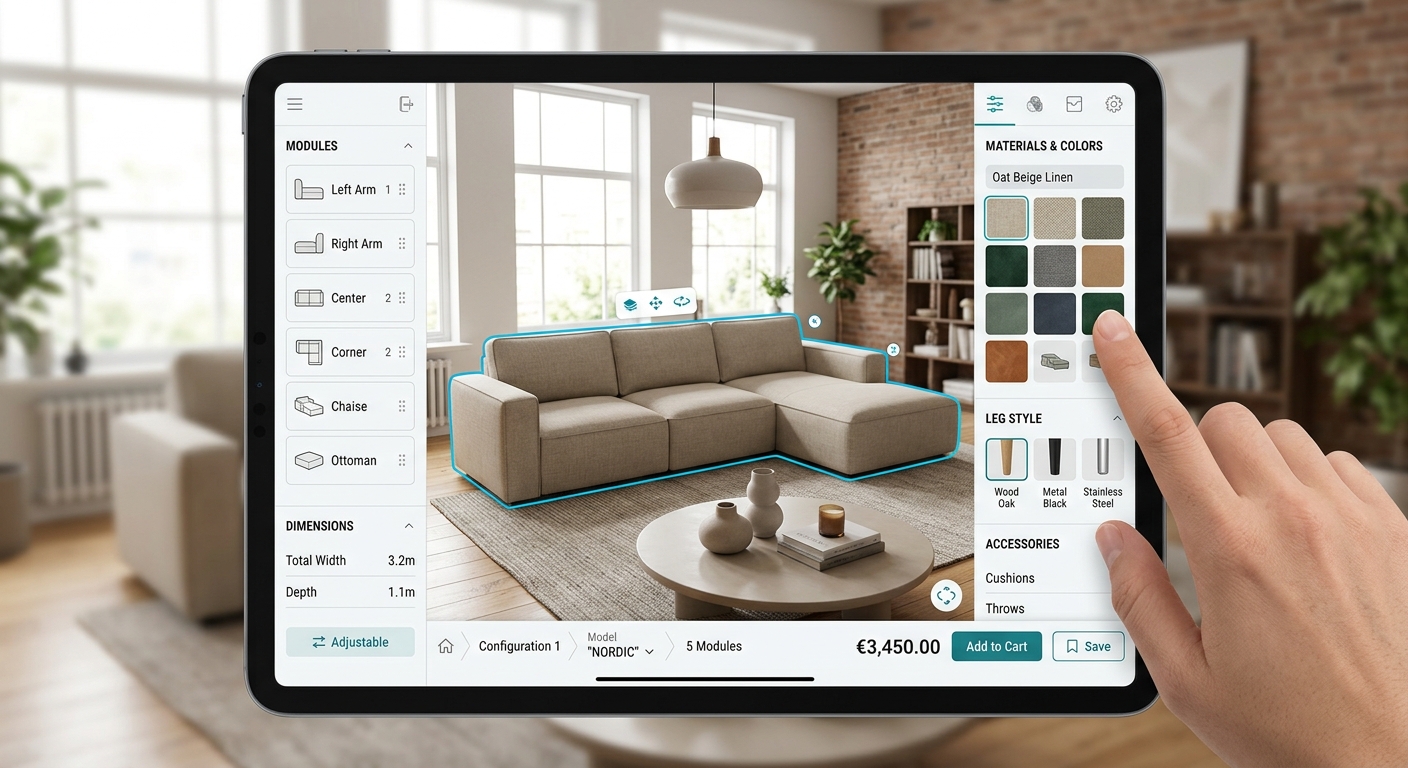
A furniture 3D configurator closes part of that gap on the product page itself. The shopper switches between fabrics and wood finishes, changes modules and dimensions, and sees the result rendered in real time — then, if you add it, places the configured piece in their own room with AR.
This article covers why furniture is unusually exposed to the fit-and-finish problem, how material rendering actually works, and how to judge whether your catalog justifies a configurator.
Why furniture is unusually exposed
Every furniture purchase is a spatial decision wrapped in a material decision. Is the footprint right? Does the tone work against the floor? Is the fabric the one that looked at home in the photograph?
Bulky goods also carry the most expensive returns in retail. The National Retail Federation’s 2025 Retail Returns Landscape estimates that 19.3% of online sales will be returned in 2025, against $849.9 billion in total projected retail returns. For a sofa, a returned order is not a small parcel — it is a two-person collection, a warehouse leg, an inspection and often a refurbishment. The cost of getting it wrong is structural, which makes preventing the mistake more valuable than optimising the recovery.
That is the commercial argument for letting a buyer see fabric and wood together, at their scale, before they commit.
What the evidence supports
It is worth being precise about what can and cannot be claimed for configurators in this category, because the category attracts a lot of confident numbers.
Shopify publishes merchant case studies on its own domain. In the Oakywood case study — a brand selling wooden workspace furniture and accessories — adding 3D models and AR was accompanied by average order value increases of 458% in Germany, 232% in Switzerland and 84% in the UK, and a move from months with almost no custom orders to roughly 200–300 per month. Those are one merchant’s reported results in specific markets, not an industry average, and they are not our results. They are cited because they are published and checkable.
What can be said generally is narrower but still useful: when fabric, wood and module choice all affect whether the buyer keeps the piece, giving them a way to resolve those choices before purchase addresses the exact reasons bulky-goods returns happen.
How material rendering actually works
The difference between a configurator worth building and a colour picker is whether materials respond to light.
We build on physically based rendering (PBR), which simulates how light interacts with a surface rather than applying a flat tint. In practice that means:
Wood finishes — oak, walnut, ash — show grain direction and pore variation, and their warmth shifts as the light angle changes. A walnut reading rich under warm interior light does not read the same under cold daylight, and the render should reflect that rather than flatten it.
Fabrics — linen, velvet, performance weave, leather — carry weave density and drape. This is the part that closes the “soft in the photograph, stiff in person” gap, which is one of the most common sources of material-based returns.
Modules and dimensions — for modular systems, the shopper sees the combination at the size their room can take, not a hero configuration that does not fit.
Because the renderer handles light physically, the same model reads correctly in a warm living room and a cool north-facing one. That consistency is what makes the preview trustworthy enough to base a decision on.
We build these on WebGL, so they run in the browser without a plugin — MDN’s WebGL documentation confirms WebGL is supported in all modern browsers. Nothing needs installing between a shopper and the configuration.
A short self-assessment
Two or more “yes” answers below suggest a furniture configurator is worth costing:
- Do your products have multiple valid combinations of fabric, finish, module or dimension?
- Is your order value high enough that one return is expensive — which, in furniture, is nearly always true?
- Are your returns concentrated in “not as described”, “wrong size” or “colour mismatch”?
- Do you offer modular or made-to-order pieces that buyers currently cannot preview at all?
A catalog of a single fixed sofa in one fabric is a poor fit — the configuration surface is too small to justify the build.
Build approaches
Subscription apps are quick to install and priced monthly. Their material rendering is typically the weak point, which matters disproportionately in furniture: if the fabric does not read convincingly, the preview does not resolve the buyer’s doubt.
Enterprise CPQ platforms handle very large catalogs and complex pricing rules, and are licensed and sized for large organisations.
Project-based custom development builds the configurator around your catalog — your fabrics, your finishes, your module system — with the configuration data belonging to you, including any export to production. For a brand where material realism is the whole point, this is usually the route that pays.
Getting the piece into the room
A configurator resolves fabric and finish. It does not resolve footprint. That is what AR adds: the configured piece placed in the buyer’s actual room at real scale, so proportion and tone are settled in context rather than imagined.
The two features share the same 3D assets, so adding AR later does not mean rebuilding the models. Our AR product preview notes cover how that works across iOS and Android — including the platform caveat that iOS support comes through USDZ rather than WebXR.
FAQ
Which customization dimensions does a furniture configurator typically cover? Fabric, wood finish, module combination and dimensions are the common set. The exact dimensions are defined against your catalog and manufacturing process before development starts.
Is the material rendering convincing enough to reduce returns? It addresses the specific reason most material returns happen — the buyer’s expectation of how a surface behaves. PBR rendering shows grain, pore and weave responding to light, rather than a flat colour. It does not eliminate returns driven by damage or change of mind.
Does it work with Shopify? Yes. The configurator is a browser-native WebGL module that embeds on the product detail page, with configuration flowing into the cart and order. Shopify accepts GLB models up to 500 MB and converts them to USDZ automatically for iOS.
Can AR be added on top? Yes, as an optional module sharing the same models. It is most valuable where fit and scale are the deciding factors — which in furniture is most of the time.
How long does a build take? It depends on catalog size and, more significantly, on material complexity. We scope both before quoting a duration rather than publishing a number that would not survive contact with your catalog.
Next step
The useful starting point is your best-selling configured pieces — the ones where buyers ask about fabric against their walls, or about whether a module will fit. Send us that list along with how your finishes and modules are structured, and we will tell you what the build involves, or whether a configurator is the wrong spend for your catalog.